
What QbCheck is
QbCheck is a computerised test that runs on a standard computer or tablet. During the test, you (or your child) respond to visual stimuli on screen while a webcam records small movements. The software measures three things simultaneously:
- Attention, how consistently you respond to target stimuli over time.
- Impulsivity, how often you respond to non-target stimuli that you should ignore.
- Activity, small head and body movements during the task, captured via webcam.
The results are compared to a normative database of people of the same age and sex. The report quantifies how your performance compares, giving us an objective data point to set alongside the clinical interview, screening questionnaires and developmental history.
What you receive
Every QbCheck, standalone or as part of an assessment, includes two things: the official QbCheck report itself, plus a clinician-written narrative interpretation that explains what the results actually mean for you.
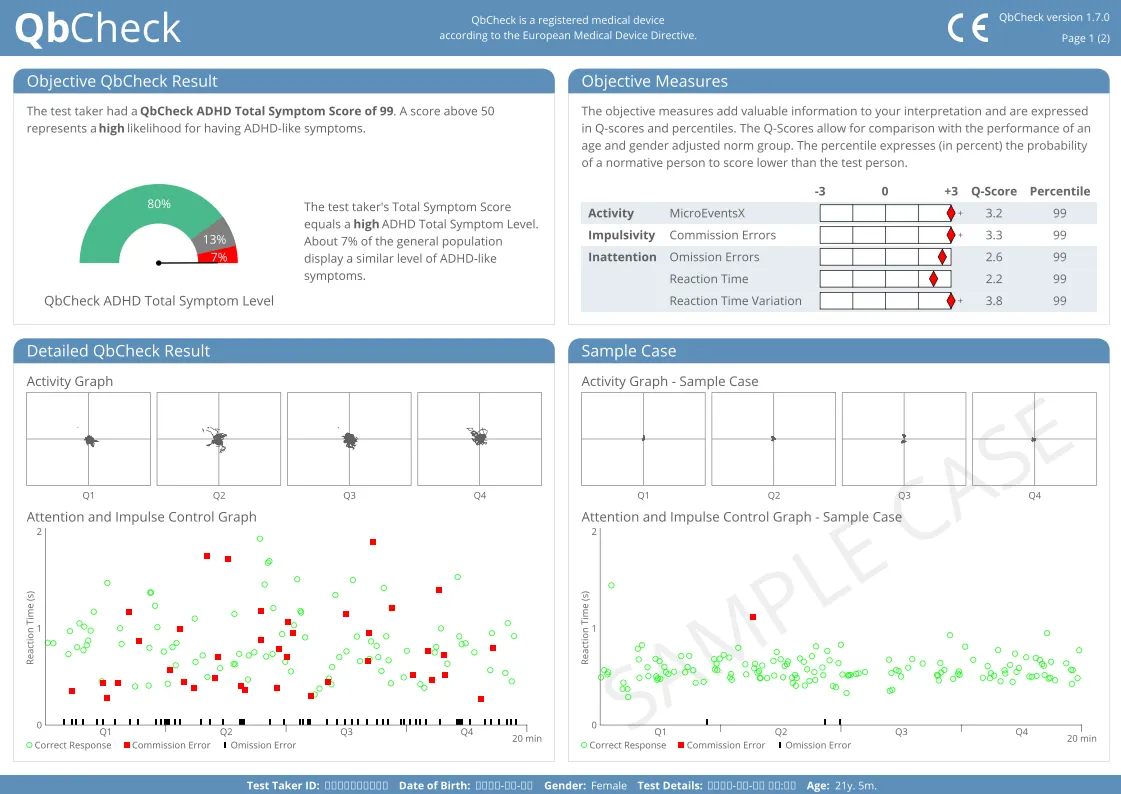
The official, CE-marked QbCheck output, your ADHD Total Symptom Score, Q-scores and percentiles for activity, impulsivity and inattention, plus activity and attention graphs compared against an age- and sex-matched normative sample.
A clinician-written report explaining what the numbers mean in your context, how the objective findings inform your ADHD presentation, where they align (or don’t) with the rest of the clinical picture, and what to do with the result.
When we recommend it
QbCheck is not a routine part of every assessment. We recommend it when the clinical picture is genuinely unclear, and an objective data point will help us reach a confident conclusion. Specifically:
When objective evidence would meaningfully strengthen the assessment
- The clinical interview is ambiguous and we want a structured tie-breaker.
- You're transferring from another service and we want to validate findings.
- You or your child have requested it explicitly, some patients prefer to have an objective measure on file.
- The presentation is unusual (e.g. predominantly inattentive in a quiet, compliant child where school doesn't see classic behaviours).
- Co-occurring conditions (anxiety, autism, depression) are complicating the picture.
- You're seeking documentation for workplace, university or DSA processes that benefit from objective evidence.
What QbCheck isn't
QbCheck is a useful tool, not a diagnostic shortcut. There are limits worth being honest about:
- It doesn't diagnose ADHD on its own. A clinical interview, developmental history and consideration of alternative explanations is always required. NICE guidance is clear on this, and so are we.
- A "negative" QbCheck doesn't rule out ADHD. Plenty of people with ADHD perform well on short, novel, motivating tasks (the "interesting test on a screen" effect). The clinical conversation remains the heart of the assessment.
- It's not mandatory. If we recommend it and you'd prefer not to do it, we'll proceed with the rest of the assessment as planned.
How it works in practice
For adults
QbCheck can be done at home on your own computer, or in clinic. You'll need a reasonably quiet room and 20 to 30 minutes uninterrupted. The software handles everything else, we send you a link and instructions, you complete the test, the results come straight to us.
For children and young people
For under-18s, QbCheck is approved by NICE as a supportive tool in ADHD assessment. The test is age-appropriate, 15 minutes for ages 6–11 to 20 minutes for 12+. It can be done in clinic (recommended for younger children, so we can ensure they understand the instructions) or at home with a parent present.
If you’re booking QbCheck as part of an assessment, we discuss whether it would add value during the appointment and only proceed if you (and your child, where appropriate) agree. If you’re booking it standalone, you’ve already made that decision, we focus on running the test cleanly and writing a narrative report that’s useful to you.
Optional within an assessment. A deliberate choice as a standalone.
If we recommend QbCheck during an assessment and you decline, no add-on fee applies. As a standalone, QbCheck is something you choose to book, worth talking through with us first if you’re unsure whether it’s the right test for your situation.
Cost and booking
QbCheck is £129, booked as a separate, additional appointment, whether alongside a NeuroFX assessment or on its own. The fee covers the test itself, a 30-minute online results appointment, the official QbCheck report and our clinician-written narrative interpretation, both provided after the call.
If you’d like to talk it through before booking, whether QbCheck is the right test for your situation, or whether you’d be better served by a full assessment, we run a short, free conversation with no obligation.
